Unknown's avatar

Prague Winter

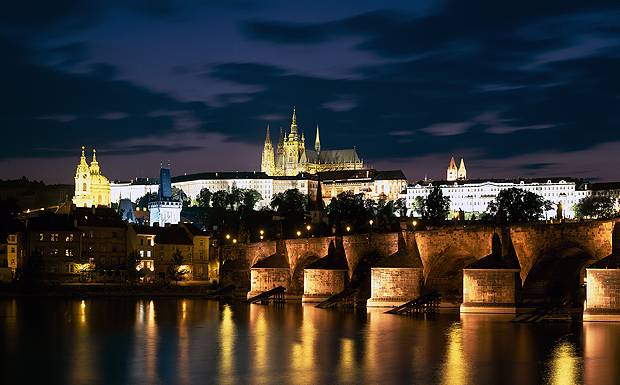
Prague Castle

I have just returned from a tea trade symposium in the Czech Republic – a trip which, given my recent positive experiences in Slovenia, I was anticipating rather keenly. Sadly, the reality did not match my expectations.

The symposium itself took place in the conference facilities of the splendidly appointed Prague Hilton but, alas, my budget did not quite stretch to affording accomodation there. Instead, I was billeted five minutes walk away on the other side of a grafitti-spattered underpass in a characterful establishment called The Embassy.

Several other conference attendees were also staying there and one of them, a wiry Scot called Ben, observed that it felt a bit like a brothel. I must bow to his superior knowledge on that front, but there was certainly something rather ripe about the busty bottle-blonde who checked me in. She was either in her 40s and trying to look 25, or in her twenties and pursuing an excessively dissolute lifestyle.

As she leaned across the reception desk to hand me my key-card I actually felt a slight breeze from the fluttering of her extravagant false eyelashes, carrying on it a faint scent of vodka fumes laced with juniper.
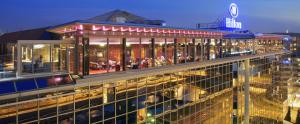
Hilton, Prague

Hilton, Prague

One might imagine that a recently-issued TripAdvisor ‘Certificate of Excellence’ (like the one prominently displayed next to The Embassy’s lift) would indicate that the establishment to which it has been awarded offers a reasonably good standard of facilities and services. It would seem, however, that this is not the case – as indicated by the following catalogue of shortcomings:

• No in-room tea-making facilities (I was, as always, prepared for this possiblity – but it should be provided by default in any hotel room, like the Corby trouser press and Gideon bible.)

• Inadequate hot-water supply – the shower was either an intermittent scalding trickle or a torrent of glacial meltwater with nothing in between, and filling the bath to a depth sufficient for wetting more than one’s buttocks and the soles of one’s feet took several hours.

• Blast-furnace heating – the radiator was so hot that one could not approach within 3 feet of it without the skin beginning to blister, and there was no way to turn it off short of crimping the pipe with a plumber’s wrench. One night I left a pair of socks on it to dry, and in the morning no trace of them remained save for a dark smear on the wall above where they had been.

• DIY room service – after a particularly gruelling day of listening to the Russian and Chinese delegations sniping at each other I decided to spend a quiet evening in my room rather than going out on the town with the other ‘tea-heads’. I ordered a delicious-sounding risotto from the room service menu and was surprised to learn that I would have to go down to reception to fetch it – something of an inconvenience as by then I had already changed into my dressing-gown and night time support briefs.

• Inconsistent breakfast provision – the one constant feature of the cooked breakfast offerings was lengths of chewy sausage like chunks of fat pepperami still in the plastic sheath. On the first day this was accompanied by a rather delicious offering of lightly sautéed potatoes in a creamy, herb-infused sauce. I sought out this tasty treat on the second day only to find that it had been replaced with penne in spicy tomato paste, then mushy vegetable rice, and on day four, mystifyingly, bread pudding. The ‘orange juice’ was of the same quality and freshness that astronauts on the first manned trip to Mars will be enjoying and the tea came out of a Liptons assortment box in which the most palatable option was, yes, Yellow Label.
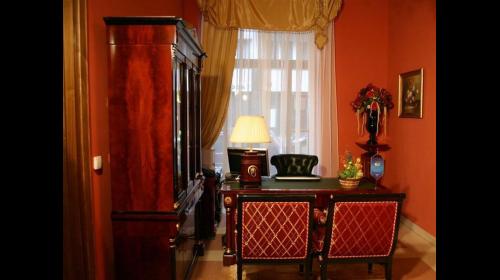
Lobby, Embassy Hotel, Prague

Lobby, Embassy Hotel, Prague

Bitter experience has taught me that breakfast tea in mid-priced continental hotels (aside from those in Germany) will seldom amount to anything worthwhile so, while I was disappointed by The Embassy’s efforts, I was hardly surprised. What did surprise me was the poor fist that the Hilton had made of providing tea for the 130 or so trade representatives attending the symposium. Where one might have expected – as is usual at this sort of event – a selection of fine leaves from the world’s most celebrated tea gardens served in bone china pots, there was instead a shallow basket of assorted sachets, many containing tealess herbal infusions, alongside a large Burco-style urn of thoroughly deoxygenated hot water. The tea, (what little there was) was German in origin, but of the rather second-rate Eilles brand whose marketing people were clearly of the opinion that any kind of black tea can be given a quality makeover by labelling it as ‘English’.
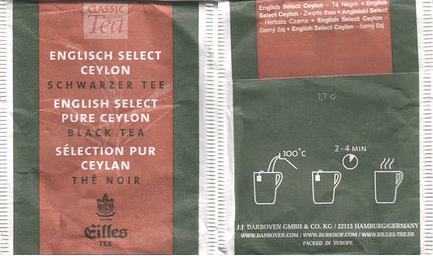
English Ceylon

To be honest, I could not understand how or why the Hilton had screwed things up so badly until I learned that the Russian organizers had arrived a few days early and blown almost the entire refreshment budget on Czech hookers. Typical.

As for the symposium itself, I did take a few notes but there was nothing of sufficent intrest to merit reporting here.

This is probably my last post before the festive season begins in earnest, so I’d like to offer all my readers a generous slice of seasonal good cheer washed down with a steaming mug of M&S Winter Spiced Tea. Pip-pip!
Unknown's avatar

Eastern Promise

© Google Maps

© Google Maps

Back in the 1970s when I was learning Geography at school there were only nine countries in mainland Europe – France, Germany, Holland, Belgium, Switzerland, Austria, Spain, Italy and Luxembourg. Each had its own easily-recognisable national characteristic – smelly cheese, clogs, chocolates, cuckoo-clocks, genocide and so on – with the exception of Luxembourg. No-one even knew where Luxembourg was, although it was generally imagined to be quite distant judging by the feebleness of the signal from its one and only radio station.

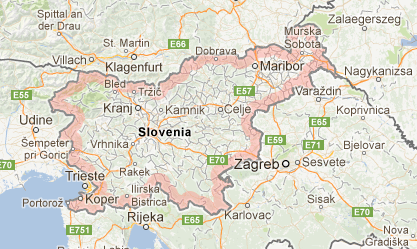
Nowadays there’s an ever-growing multitude of European nations – more than a hundred if the Eurovision Song Contest is anything to go by – and I freely admit that I had to reach for my gazetteer when I received an unexpected tip-off from a reader in Slovenia. (It’s just south of Austria, if you’re curious.) The young border town of Nova Gorica was the location, and I was was surprised to discover that half of it lies in Italy, where it’s called Gorizia. Readers of my report from Sanremo earlier in the year will understand why this set more than a few alarm bells ringing. Mere proximity, however, is no reason to tar the good people of Slovenia with the Italian brush so, with a weekend in hand, I packed my valise and headed east.

Nova Gorica

Nova Gorica – A sort of Slavic Peterborough

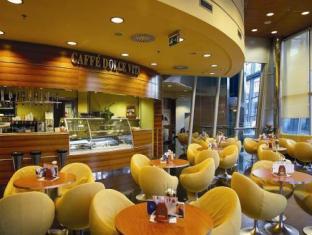
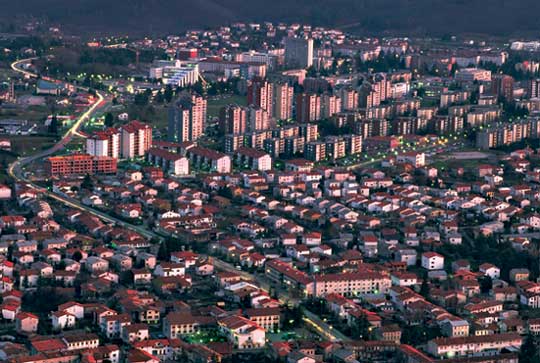
The first thing one notices about Nova Gorica is that there’s a casino on virtually every street corner, but that’s where the similarities with Las Vegas end. Nondescript residential and business zones, clusters of Soviet-era housing blocks and a Brutalist shopping centre complete a provincial townscape conspicuously lacking in glamour or razzamatazz. Most of the casinos look like somewhere you’d go to get your car serviced, but the Perla Hotel and Casino, situated in the centre of the town, exudes a modest degree of swank, with entrances done out in an exuberant nautical style, perhaps to give punters the impression that they are boarding an exotic cruise liner.  This, unlikely as it seemed, was the destination to which my correspondent had sent me – and there, to the right of the lobby, lurking behind a row of glass cases filled with gaudy souvenirs just as he had described, I found the Kaffè Dolce Vita.

Kaffè Dolce Vita (it's usually busier than this)

It’s usually busier than this

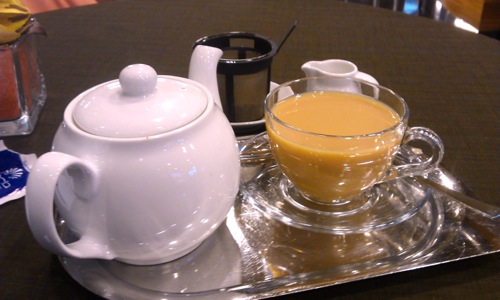
Nestled in a crescent-shaped space hugging the outer wall of the hotel, the café has a moderately cosy atmosphere despite a preponderance of glass and stainless steel, and as I entered I was welcomed by a winning smile from a statuesque blonde waitress with a slight stoop and an interesting nose. I always start with a pot of English Breakfast Tea when breaking new ground. It’s not a mathematically precise standard, but there are certain boxes that should be ticked – robust, earthy flavour; rich, dark colour, and plenty of Assam in the blend. It’s surprising how far short of these benchmarks some ‘English Breakfast’ varieties fall. On a visit to Connecticut last year I was confounded by a brew composed entirely of smoked Chinese leaves – the only connection with English breakfast I could discern was that it smelled like kippers and after just one mouthful I had to gargle with grapefruit juice to get rid of the taste. Fortunately, there were no doubts about the quality of the tea at the Dolce Vita as it was supplied by Ronnefeldt, a German importer and blender with impeccable credentials. The question was, would the waitress do it justice? I watched with some satisfaction as she confidently spooned a measure of loose leaf into a mesh basket, dropped it into a pre-heated porcelain pot and sluiced the contents with demonstrably boiling water. I forgave her for offering me a choice of milk or lemon (only people with severe lactose intolerance issues should consider taking EBT without milk) and carefully carried the small oval silver tray to my table.

Dolce Vita Tea

Satisfaction guaranteed

After such conscientious preparation the tea was hardly going to disappoint, and sure enough it set my taste-buds dancing and singing with delight from the very first sip. The truly remarkable discovery came when I went to pay for it and found that the total bill, including a generous slice of apple strudel, came to only €3.60 – about the same as you’d pay for a cardboard bucket of swill and soggy flapjack at the Upper Crust concession on Paddington Station. Realising that my tea budget would go significantly further than I had anticipated I greedily scanned the dozen or so other varieties on offer behind the counter and picked out a fine Darjeeling for my next pot – this time with a wedge of lemon.

With two days to fill I had planned sight-seeing trips to the Karst caves and Triglav National Park, but after the fourth pot I was feeling excessively relaxed and the weather was dreadful so, taking a necessary break from my libations, I wandered into the gaming area of the Casino. The customers, as far as I could tell, were predominantly Italian and mostly over 50, although there were quite a few young men with bouffant hair and unfeasibly tight trousers gliding up and down between the banks of slot machines, probably on the lookout for lonely widows having a flutter with the life insurance payout. The agents of fortune were on my side that day, and after half an hour of pulling levers and pressing buttons I had increased my original modest stake tenfold. Feeling flush, I graduated to the roulette tables where, in fairly short order, I bagged enough moolah to cover the entire cost of my Slovenian jaunt. That seemed like a good point at which to count my chickens, so I cashed my chips and returned to the Dolce Vita for a celebratory pot of sweet-smelling Ceylon. I was there again when the doors opened on the morrow and while the rain lashed down outside I spent a gloriously lazy day filling myself with tea and pastries and reading my hardback copy of The Hydrogen Sonata. It’s hardly the stuff that travelogues are made of, but by the time I retired to bed I felt as if I had lived the life of Bacchus.

A big hvala then, to Mr Marius Kovska for drawing my attention to this exemplary establishment. It’s clear that Slovenia has much to offer for the curious traveller and I fully intend to return for a longer stay when the weather has improved so that I can discover more about this overlooked corner of the new Europe.

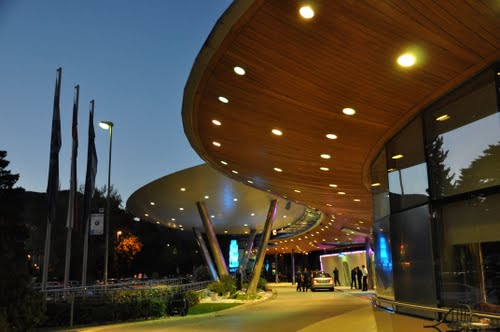
Perla Hotel and Casino

I’ll be back…