
Product review:
Camelbak Forge Vacuum Insulated Travel Mug
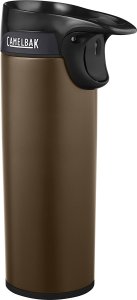
Regular readers will know the trouble I’ve had tracking down a decent cuppa in the southern latitudes of Europe. For the serious tea enthusiast, it would be an act of madness to visit any EU country that lies wholly or partly below the 45th parallel without packing a travel kettle and a large caddy of quality leaf. Thus equipped, you can at least ensure that your away days will be bookended with a satisfying brew.
That still leaves the problem of what to do when you are out and about during the day. I mentioned this to my niece, who spends much of her spare time hiking and biking in the great outdoors, and she suggested, without hesitation, that I should get myself a Camelbak. It’s an Australian brand with a solid reputation amongst the Ray Mears set, and there were plenty of their wares on display at my local branch of Go Outdoors. I plumped for the pricier end of the range, shelling out £30 and change for the model illustrated above. Aside from the excellent build quality, its headline feature is an ingenious spring-loaded seal, enabling the contents to be enjoyed without the need to faff around with a screw-top lid or suck on a teat. I immediately put it to the test with a trip to the Italian Grand Prix where it ended up facing a far sterner challenge than anything I had envisaged.
Hotels near the circuit in Monza were charging outrageously inflated rates, so I booked myself and my young travelling companion, Huw, into a more reasonably-priced establishment just a few hundred yards behind the central station in the heart of nearby Milan.
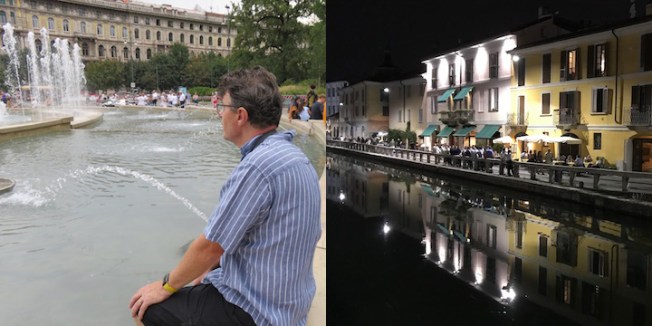
Uptown
The sprawling capital of Lombardy, we discovered, is a city of two halves, separated by a line running perpendicular to the rail terminus. Out front, broad piazzas, grand apartment buildings and luxury retail outlets; to the rear, grimy flophouses and 24-hour kebab shops. That first walk from the station to the hotel, trundling our cases through a grid of pot-holed, poorly lit streets watched by groups of shifty-eyed men lurking in doorways, seemed to take an uncomfortably long time. Fortunately, we were not the only race-goers staying in that part of town, and there were several others beating a similar path.
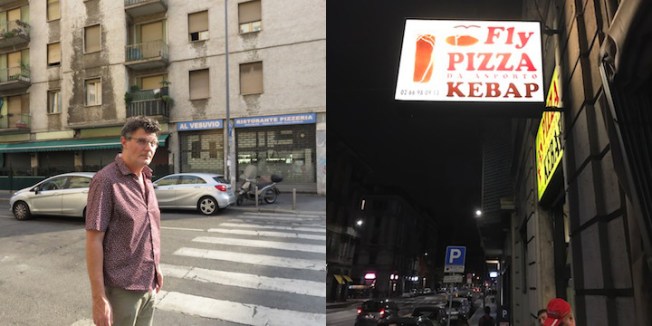
Downtown
The next morning I filled my new tea-vessel with robust full-leaf Assam and stowed it in my backpack, intending to leave the contents undisturbed until I had taken my seat at the track. Travel time from hotel to circuit was around 80 minutes, comprising a half-hour train journey, a tightly-packed bus ride and a lengthy march through the extensive lawns and woodlands of the vast Parco di Monza. I estimated that getting past the security scrum and locating our stand was going to take at least another 40 minutes. So, I wondered, was my brew going to pass muster after two hours ‘in the can’?
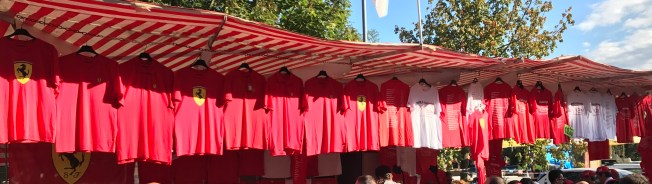
Red Brigade
That question remained unanswered because – as Huw and I belatedly found out when we reached the cordon of heavily armed Carabinieri at the entry checkpoint – no metal or glass drinks containers of any kind were being allowed into the circuit. Great heaving mounds of confiscated cans and bottles were building up on either side of the barriers, and I can assure you, dear reader, that my expensive new flask was not about to join them. The obvious solution was to double back 50 yards or so and find somewhere to stash it in the woods. Feeling disinclined to share this somewhat undignified plan with the glowering, sweaty-browed officers barring my way, I smiled politely and told them I would take the offending item ‘back to my car’.
My confident assumption that Huw would back me up in this mild deception proved to be tragically wrong.
“We haven’t got a car!” he squeaked in a sort of strangled falsetto. His face was tinged a sickly shade of green, his head pulled so low to his shoulders that his chin was virtually embedded in his chest. The poor, dear boy. I had forgotten how agitated he becomes in the presence of firearms. Even the sight of a potato gun is enough to give him the collywobbles. Not that I was feeling sympathetic right at that moment.
“Yes we have” I hissed urgently, “and I’m going to take this flask back to the car park and leave it in the car!”
“We haven’t got a car!” he bleated again, more loudly this time, his gaze mortally transfixed by the carabinieri’s gleaming instruments of death.
It could have been a sticky moment, but I’m happy to report that we were not summarily dragged away and tossed into a barbed wire holding pen. Thanks to Huw’s bracingly strong Valleys accent, the Italians had not had the faintest idea what he was actually saying.
Trackside
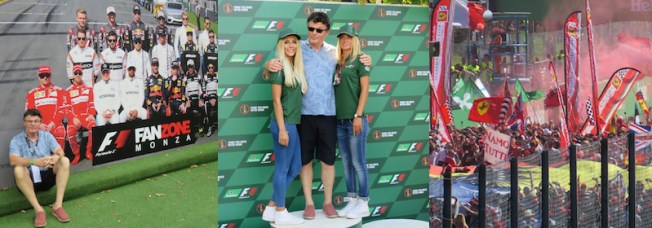
The race action that day was a tad predictable but the hordes of cheering, red-shirted Tifosi crowding the stands made for a lively atmosphere. Tea was on sale nowhere, so I had to keep myself topped up with the powdered variety in capsule form. This is rather like using nicotine patches, in that it satisfies a base need without actually giving any pleasure.
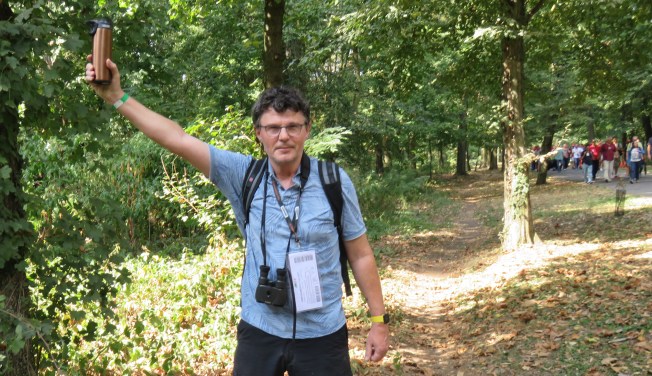
After the session, when I returned to the distinctively gnarled tree behind which I had concealed the flask, my only hope was that it would still be there. I had no expectations regarding the contents and was amazed and delighted to find that the liquid within was, after almost eight hours, still of good flavour and palatably warm. It was a far more satisfying result than anything that had happened on the track.
Reunited!
Since then, my Camelbak Forge has seldom strayed far from my side. It regularly accompanies me on dog walks, bus rides and visits to the cinema, and never disappoints. Heartily recommended.
 theteacaddyuk